


Most influencer campaigns don’t fail at the reporting stage. They fail at the brief stage — quietly, before a single creator has agreed to post.
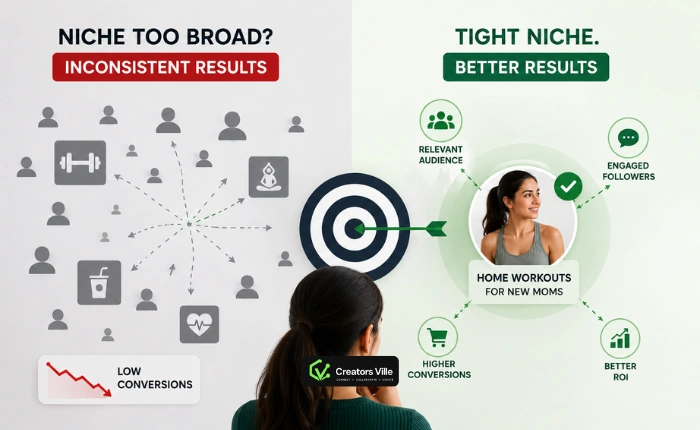
The specific culprit: brands define their creator niche too loosely. “Fitness and wellness.” “Lifestyle.” “Women 18–34 interested in beauty.” These aren’t niches. They’re demographics. Hand a vague niche to a creator roster and what comes back is inconsistent content — posts that feel like they belong to five different brands. Inconsistent content produces inconsistent view performance. Inconsistent views produce an unpredictable cost-per-view that is almost impossible to defend in a budget review.
Then the internal meeting happens. Someone pulls up paid search’s ROAS number — clean, traceable. Influencer marketing loses the argument. Budget migrates to paid search not because it’s cheaper, but because the numbers are easier to defend in a spreadsheet. The channel gets blamed for underperforming when the real problem was a targeting decision made in the first fifteen minutes of campaign setup.
This is fixable. But only if you understand exactly where the cascade starts.
The Cascade Nobody Draws on a Whiteboard
You define your niche broadly because you want volume — more creators, more reach, which feels safer. You filter by engagement rate and follower count. A 3% engagement rate sounds strong. What that number doesn’t tell you is whether the audience falls inside your buyer persona or price sensitivity band — and with a broad niche, it almost never does entirely.
Each creator then interprets the brief differently, because a broad niche permits it. One posts a morning routine. Another, a gym transformation. A third does a talking-head product review. All technically “fitness and wellness.” All performing differently. Your Creators Ville Live Campaign Dashboard shows the spread: some posts generating strong view counts, most mid-range, a few flat. You average the results. The average looks acceptable. You greenlight the next campaign with the same niche definition.
The average is hiding a structural problem. Flat performers drag down cost-per-view. On a pay-per-view model — where you only pay for views a campaign actually produces — they don’t waste money directly. But they waste calendar time, creator relationships, and reporting credibility. They produce content that can’t be amplified through paid social because it’s off-brand. And they make it impossible to identify which type of creator actually works for your product.
That last loss is the most expensive. You can’t learn from a broad niche because there’s no signal to isolate.
What “Tight Niche” Actually Means in Practice
A tight niche is not about follower count. It is not about platform. It is about the specific intersection of content type, audience intent, and purchase proximity.
Consider the difference between “fitness” and “home workout routines for new mothers returning to exercise.” The second tells you what the audience is doing, what they need, and roughly where they sit in a buying journey. A D2C supplement brand targeting that niche can brief a creator with real specificity. The creator knows the angle. The audience recognises themselves in the content. View completion rates go up. Shares go up. The metrics that actually correlate with conversion move.
A creator with 30,000 engaged followers in a specific niche consistently outperforms a celebrity with 3 million followers on the performance metrics that matter to a D2C brand. That’s not a counterintuitive opinion — it’s a function of audience intent. Specificity creates relevance. Relevance drives action.
73% of brands now prefer to work with micro and mid-tier creators — micro-influencers defined as those with 10,000–100,000 followers — precisely because of this dynamic. But preferring micro-influencers and briefing them correctly are two different decisions. Most brands nail the first and fumble the second.
The Brief Failure Is Separate From the Payment Model
Worth being direct: tightening your niche and fixing your brief is not the same thing as switching to a performance-based payment model. Both matter. They solve different problems.
A vague creative brief suppresses creator acceptance rates and causes calendar slippage regardless of what you pay. Creators who receive an unclear brief either decline or post something generic. Neither serves you. The brief problem is upstream of everything else — payment model, platform selection, reporting cadence, all of it.
The payment model problem is distinct. 78% of brands now prioritise performance-based payment models over flat-rate agreements, up from 52% in 2023. The shift makes sense: flat fees transfer all the risk to the brand. But there’s a failure mode brands frequently walk into — bolting a performance bonus onto an existing flat fee. “We’ll pay the base rate, plus a bonus if you hit a view threshold.” This does not change creator behaviour, because the base fee already provides financial security. The incentive structure is cosmetic.
A genuine pay-per-view model — payment tied directly to views generated, no floor to coast on — creates a fundamentally different dynamic. It also makes tight niche definition more important, not less. On a pure performance model, inconsistent content is a financial problem as much as a strategic one.
How to Tighten Before You Launch
Here is the sequence to run before any campaign goes live.
- Write the audience before you write the niche. Describe the specific person who buys your product: what they do on Sunday mornings, what problem they’re solving, what content they’re already consuming. Then work backward to the creator type who speaks to that person.
- Use all three filter dimensions when searching creators. Niche alone is not enough. Filter by region — critical for city-specific campaigns or India-focused audiences — and by engagement level, meaning the type of engagement that signals genuine audience interaction rather than passive scrolling or comment pod activity.
- Brief the content format, not just the product. Tell creators what a good post looks like — the hook style, the tone, the call to action. Specific briefs produce content that performs consistently enough to generate real learnings. Vague briefs produce vague content, full stop.
- Set up attribution before outreach, not after. UTM links, unique discount codes, consistent content tagging — without a single attribution source of truth, ROI decisions degrade into gut calls and budget cuts follow. This infrastructure needs to exist before the first creator posts, not after the first report is due.
- Validate niche fit with a small cohort first. Don’t launch across your full creator list simultaneously. Run two or three tightly defined sub-niches, monitor view performance and engagement patterns from the Live Campaign Dashboard, then scale the sub-niche producing consistent results.
What the Numbers Say About Where This Market Is Going
The macroeconomic argument for getting this right has never been stronger. In 2024, the average CPM for influencer marketing across all platforms fell to $4.63 — a 53% drop from the prior year. D2C brands now reach more than double the audience for the same budget compared to two years ago. At that cost efficiency, a well-targeted campaign compounds quickly. A poorly-targeted one wastes an opportunity paid search cannot replicate.
62% of brands are increasing their influencer marketing budgets in 2026. The ones growing their allocations aren’t running broader campaigns — they’ve built a repeatable process: tight niche, clear brief, performance-based payment, clean attribution. They can demonstrate the mechanism to a finance team, which is the only thing that protects the budget line.
The influencer marketing platform market was valued at $34.2 billion in 2025 and is projected to reach $116.2 billion by 2033, at a 14.4% compound annual growth rate. That growth is being driven by brands moving from experimental spend to systematic, accountable programs. Systematic means tight niche. It means knowing, before a campaign launches, exactly who the creator is speaking to and why that audience buys.
The Platform Question
None of this works if your tooling can’t support the process. Creator discovery needs to be filterable at the sub-niche level — not just “fitness,” but the intersection of fitness, region, and engagement depth. Campaign monitoring needs to be live, not weekly exports into a spreadsheet. And the payment model needs to be built into the platform logic, not bolted on through manual invoicing after the fact.
Platforms built for serious influencer campaign management handle creator filtering by niche, region, and engagement level as a baseline. They track performance, engagement, and ROI from a single dashboard — which is what makes the attribution problem solvable without a separate analytics stack.
The brands that get this right configure their campaign workflow before they start creator outreach. That sequencing — workflow first, outreach second — is why most users on Influence go live within 24 hours rather than spending weeks in setup. The platform isn’t faster; the process is.
Get the niche tight. Write the brief before you filter. Build attribution before you post. Then scale what works.
Set up your Creators Ville campaign — filter creators by niche, region, and engagement level, monitor results from a live dashboard, and pay only for the views your campaign actually generates.