

Most D2C marketing teams are still negotiating flat fees with large-follower creators — paying for reach they can’t verify, into audiences they haven’t mapped to their buyer persona. Meanwhile, brands filtering for niche micro-creators on engagement are spending less and converting more. The gap between those two approaches is widening fast.
India crossed 100 million creators in 2026, making it one of the world’s largest and fastest-growing influencer ecosystems. The brands winning aren’t the ones booking the biggest names. They’re the ones picking the right-sized creators for the right product category and paying only for the views those creators actually deliver.
This article is about how to do that — and the mistakes that drain budgets before a single sale comes in.
The Reach Trap Is Real, and It’s Expensive
Here’s the counterintuitive truth: a creator with 30,000 highly engaged followers in a specific niche will outperform a celebrity with 3 million followers on almost every performance metric that matters to a D2C brand. Not sometimes. Almost every time.
Why? Because celebrity audiences are diffuse. A macro-creator’s millions of followers span age bands, income brackets, and regions with no shared intent. If you’re selling a ₹1,800 skincare serum to urban women aged 22–34, you’re paying for reach into a crowd that mostly won’t buy. The celebrity charges a flat fee regardless of who converts.
Brand sponsorships and influencer partnerships now hold an estimated 31.4% share of creator monetisation in India in 2025 — the largest slice. Competition for genuinely high-converting creators is intensifying. Paying flat fees for reach you can’t verify isn’t a strategy. It’s a gamble with your Q3 budget.
Engagement Rate Alone Is a Trap Too
Don’t assume filtering by engagement rate fixes the problem. It doesn’t, not by itself.
A 3% engagement rate is a misleading metric if the audience falls outside your buyer’s persona or price sensitivity band. A creator in the fitness niche with a highly engaged following of teenagers is useless to a brand selling premium protein powder to gym-going adults with disposable income. The rate looks healthy. The conversion is zero.
The signals that actually matter go deeper: comment-to-like ratio, meaningful comment rate versus repetitive comment detection, save and share rates, and click-through from bio links. Engagement authenticity metrics at this level separate a performing creator from one gaming vanity numbers through comment pods and follow/unfollow churn. Sudden follower spikes are a red flag. So is a comment section full of fire emojis and zero questions about the product.
Filter for engagement. Then filter what that engagement actually looks like.
The Filtering Framework That Works for Indian D2C
Broad categories first, then narrow hard. This is the order that saves budget.
Step 1 — Lock niche before region. Define your product category tightly. Skincare is not a niche. Ayurvedic skincare for oily skin is closer. Define the buyer persona first; the niche follows from that. Defining niche too broadly is one of the three named failure modes for influencer campaigns — it produces inconsistent content and unpredictable cost-per-view.
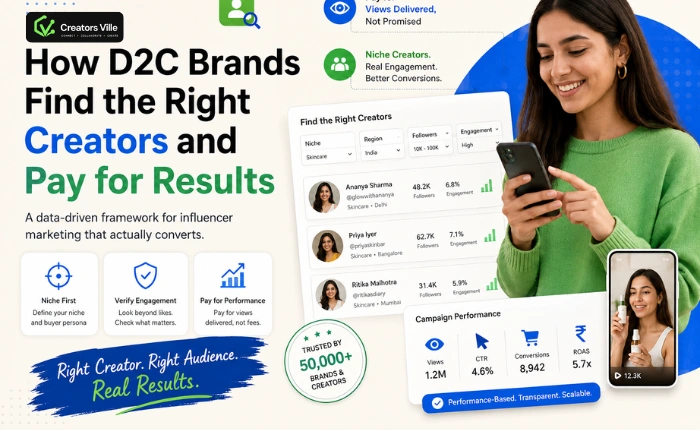
Step 2 — Filter by region for language fit, not just geography. India’s creator ecosystem is deeply regional. A Hindi-speaking macro-creator based in Delhi reaches a different buyer than a Tamil-speaking micro-creator in Chennai, even if both audiences look similar on a demographic slide. Match language and cultural register to your product and market. Creators Ville lets you filter creators by niche, region, and engagement level simultaneously — so you’re not cross-referencing a shortlist across three separate tools.
Step 3 — Prioritise micro-creators (10K–100K) for most D2C categories. Micro-influencers consistently outperform celebrities on audience trust and interaction rates. For a first campaign or a new product launch, this tier gives you the most signal per rupee spent. You can scale what works.
Step 4 — Don’t pay upfront for unproven creators. A pay-per-view model — where you pay based on views the campaign actually produces, not a flat fee negotiated in advance — changes the risk profile entirely. 78% of brands prioritised performance-based payment models over flat-rate agreements in 2025, up from 52% in 2023. The market has moved. If your current platform only supports flat fees, that’s a structural problem, not a negotiation problem.
Set Up the Workflow Before You Touch Outreach
This kills more campaigns than bad creator selection does. Teams rush to shortlist creators and fire off outreach before the campaign infrastructure exists. No brief. No usage rights clause. No product shipping plan. No UTM structure.
Then everything stalls. The creator posts. You can’t amplify it because you never secured usage rights. The product arrived late because no one held inventory. You can’t attribute the sale because the UTM wasn’t set. You spend 6–10 hours after the fact stitching together UTM links, code redemptions, and Shopify data by hand for a mid-size drop that should have been automated.
The right order is: configure the workflow, then reach out. Teams that configure their campaign workflow before reaching out to creators are live within 24 hours. Teams that run outreach simultaneously with workflow setup take weeks — and launch in a worse state than if they’d waited two days.
Three things to lock before your first message to a creator:
- Usage rights, in writing. If you plan to run paid amplification or repurpose content in regional ads — increasingly common as brands adapt creator content for platform-specific placements — this has to be agreed upfront. It cannot be retrofitted after posting.
- Product logistics confirmed. For product seeding campaigns, inventory holds and shipping timelines need to be mapped before creators are briefed. A creator who receives your product three weeks late posts late, or doesn’t post at all.
- Go/no-go thresholds defined. Before the pilot runs, know your benchmarks: time to first post under 7 days, a CTR above 3%, a breakeven ROAS as your go/no-go criteria. Deciding them after the results are in is how confirmation bias enters the budget conversation.
Product Seeding as a Low-Risk Entry Point
If your brand is new to influencer marketing, or new to a creator tier, start with product seeding before paid campaigns. Send product. No fee commitment. See who posts organically and what the content looks like unprompted.
This works particularly well for e-commerce brands where the product experience is the story — categories where unboxing, texture, smell, or visible results carry the post without a script. Nano-creators (under 10,000 followers) will often post for product alone. The content is frequently more credible than anything briefed. And for a D2C brand that doesn’t yet know which creator voices resonate with its buyer, seeding a broader set of micro and nano creators generates real data cheaply.
Creators who post without prompting, respond quickly, and generate comments with genuine product questions — those are the ones worth converting to paid, pay-per-view relationships. You now have performance data before you’ve committed significant budget. That’s the right order.
What the Numbers Say About Where India Is Heading
Eighty percent of brands maintained or increased their influencer marketing budgets in 2025, with 47% raising budgets by 11% or more. And 62% of brands are increasing their influencer budgets again in 2026, per Linqia’s State of Influencer Marketing Report. This isn’t a trend that reverses. The question for Indian D2C brands isn’t whether influencer marketing works. It’s whether they’re running it in a way that generates data they can act on — or just generating spend they can’t explain.
The platform market itself was valued at $34.2 billion in 2025 and is projected to reach $116.2 billion by 2033, growing at a 14.4% compound annual rate. Infrastructure is maturing fast. The brands that build disciplined workflows now — niche-first filtering, performance-based payment, pre-configured campaign infrastructure — will have a compounding advantage over those still negotiating flat fees against reach metrics they can’t verify.
India has the creators. The question is whether you have the workflow to find the right ones and pay them the right way.
AI-powered matching has made the filtering step faster — Creators Ville’s AI-Powered Campaign Matching surfaces creators by niche, region, and engagement level from a single dashboard. But it doesn’t replace the strategy. The platform finds creators matching your parameters. You still have to define those parameters correctly. That’s the work no tool does for you.
Start there. Lock niche, region, engagement thresholds. Build the campaign brief before outreach. Use product seeding to generate real data before committing to paid. Pay for views generated, not views promised.
If you want to run this end-to-end without middlemen or hidden fees, start your Creators Ville trial today — trusted by 50,000+ brands and creators, with most campaigns live within 24 hours.