

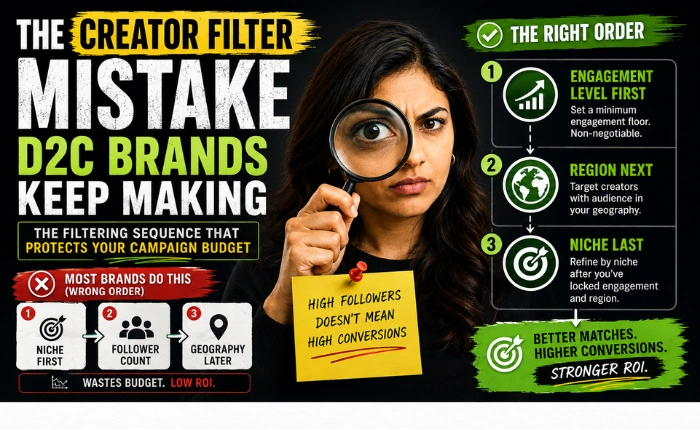
The global influencer marketing industry crossed $33 billion in 2025, up from $21.1 billion just two years earlier — and in 2026, that money is still largely being wasted the same way. Brands filter creators by niche first, sort by follower count, glance at geography as an afterthought, and treat engagement level as a final checkbox. That sequence is backwards. And it costs real money.
The sequence almost every brand defaults to: pick a niche, sort by follower count, check if the creator is vaguely in the right geography. Engagement level — the single variable most predictive of whether anyone actually buys anything — gets treated as an afterthought, something you scan in the final five minutes before sending a brief.
Why Niche-First Filtering Feels Right But Isn’t?
Niche filtering is intuitive. You sell protein supplements, so you want fitness creators. You sell skincare, so you want beauty creators. The logic is clean. The problem is that niche is the least differentiating variable you can filter on. Every brand selling protein supplements has already thought to target fitness creators. You are competing against dozens of other brands for the same pool of creators — which drives up rates and delivers diminishing results.
More damaging: a creator can be perfectly niched and have catastrophically low engagement. A fitness influencer with a large following but near-zero audience interaction will cost more per actual human reaction than a smaller creator in the same niche who drives consistent engagement. Follower counts have been inflated, bought, and gamed for years. Engagement rates are harder to fake at scale.
Campaigns that get creator selection right consistently outperform the industry average ROI — but plenty land well below a 1:1 return, and they almost always share one trait: the brand picked creators who looked right on paper but had no real audience pull.
The Filtering Order That Actually Works
Here is the sequence I’d use, and the sequence that Creators Ville — an influencer-marketing platform for discovering creators and running campaigns from one dashboard — is built around: engagement level first, region second, niche third.
Step 1: Set Your Engagement Floor Before Anything Else
Before you look at a single creator’s content or follower count, decide what engagement level you will not go below. Write it down as a specific percentage — not “high engagement,” a hard number. This is non-negotiable, not a preference.
The reason this has to come first: it dramatically shrinks the pool you’re evaluating. That’s a feature, not a bug. You don’t want to spend three hours reviewing creators who are going to underperform. Let the filter do that work.
Here’s how this plays out. Say you’re a D2C skincare brand. You open a creator search with no engagement floor and find a sprawling list of beauty creators in your target region. You apply a firm engagement floor. The pool shrinks sharply — far fewer names, and that feels uncomfortable, because teams are trained to equate more options with more opportunity. But the creators who cleared the engagement floor are the only ones worth briefing. The rest were never going to drive the responses you needed. The filter didn’t remove opportunity; it removed the illusion of it.
Engagement level filtering in Creators Ville is built as a first-class control, not buried in an advanced-settings panel. Use it first. The pool that remains after you set a meaningful engagement floor is the only pool worth your time.
Step 2: Filter by Region Next
This is where most brands lose budget they don’t even notice losing. A creator based in Mumbai with a following concentrated in tier-1 Indian cities is a fundamentally different proposition from a creator who looks identical on paper but whose audience is split across five countries. If you’re a D2C brand shipping domestically, audience geography is money. An engaged follower in a geography you can’t convert is just a vanity metric.
Region filtering matters especially for brands operating in India, where audience concentration by state and city tier drives conversion rates in ways that national follower numbers completely obscure. The mechanism is direct: a creator whose audience clusters in the states where you actually ship converts at a fundamentally different rate than one whose audience is fragmented across the country. The follower count can look identical. The revenue outcome won’t. Creators Ville is trusted by 500+ brands across India, and the region filter exists precisely because this variance is real and measurable at the campaign level.
Apply region before niche. A creator who passes the engagement floor and whose audience is actually reachable by your product is already two-thirds of the way to being a good match. Niche, at that point, is a refinement — not the foundation.
Step 3: Niche Is the Final Refinement, Not the Starting Gate
Now you filter by niche. The creators you’re looking at have already cleared your engagement floor and your regional relevance test. Niche filtering here does what it’s actually good at: ruling out creators whose content context is genuinely incompatible with your product category.
Notice the difference in how niche is functioning. You’re not using it to find creators. You’re using it to rule out the wrong ones from a pool that has already been qualified on the variables that predict performance.
Also consider niche adjacency. A food creator who consistently posts about sustainable packaging is probably a better match for an eco-packaging brand than a generic sustainability creator with low engagement. Niche labels are coarse. Engagement and region are precise. Filter coarse-to-fine, not fine-to-coarse.
See the three-step filter in action — explore the Creators Ville product and how creator filtering works end-to-end.
What Cheaper Reach Changes About This Calculus
More creators entered the market in 2024. More inventory became available. According to platform data compiled by Bizkol, Instagram remains the dominant influencer channel with 80% of marketers running campaigns there in 2025 — and as supply expanded, reach in raw terms got cheaper across the board.
That sounds like good news. It mostly is — D2C brands can now reach significantly larger audiences for the same spend. But cheaper reach creates a trap: it makes it tempting to chase volume. More creators, broader reach, bigger numbers. The brands that fall into this trap loosen their engagement floor to get more creators in the pool, reasoning that cheap reach makes up for lower engagement.
It doesn’t. Cheap impressions from unengaged audiences are not a substitute for fewer impressions from audiences that actually respond. Flat-fee influencer deals that pay for presence rather than performance are the logical endpoint of chasing volume — you pay regardless of whether anyone watched, clicked, or bought. Cheaper reach makes that mistake easier to make and harder to notice until the campaign closes.
Creators Ville’s model — where brands pay creators for views generated rather than upfront flat fees — structurally prevents this. If a creator’s audience isn’t watching, you’re not paying for their disinterest. That model only works in your favour if you’ve also filtered for engagement, because stopping upfront payments is only half the fix — you still need creators whose audiences are primed to engage.
The Friction Point Nobody Talks About: Brief-Ready Creators
A well-filtered shortlist is smaller than what brands expect. After setting a real engagement floor and a regional constraint, you might have 30 creators instead of 300.
That’s correct. Work the smaller list harder. Use it to inform better briefs. Monitor performance from Live Campaign Dashboards with enough attention to actually learn something — which content formats drove engagement, which creator’s audience responded to product-first messaging versus lifestyle-first messaging. That knowledge compounds. The brand that runs five well-filtered campaigns learns more than the brand that runs fifty poorly filtered ones.
For more on building campaigns around qualified creator shortlists, the influencer collaboration strategies guide covers how to brief creators once you’ve filtered correctly — and how to structure the collaboration for engagement, not just reach.
A Note on What AI Matching Does and Doesn’t Replace
AI-Powered Campaign Matching accelerates discovery. It’s useful, and for brands running campaigns at scale across multiple niches, it’s close to necessary. But matching is not a substitute for understanding your own filtering logic.
If you don’t know what engagement floor you’re willing to accept, or what regional concentration matters for your product, an AI match will surface creators who fit some version of your profile — not necessarily the right version. Think of AI matching as a search accelerator you point in a direction. The direction still has to come from you.
The brands that get the most out of AI-driven influencer discovery are the ones who have already done the work of defining their non-negotiables. Engagement floor. Regional requirements. The niche parameters that genuinely matter versus the ones that just feel right.
The Practical Setup
When a brand sets up a profile on Creators Ville — goals, budget, target audience — the filtering infrastructure is ready immediately. Most users go live within 24 hours of setting up their workflow. The speed is real. The question is whether the time before launch was spent defining the right filters or just picking the obvious niche and moving on.
Do this before your next campaign:
- Write down your engagement floor. A specific number. Not “high engagement” — a percentage you will not go below, written before you open any search tool.
- Map the regions where a sale actually helps you. If you’re domestic D2C, be precise about which states or city tiers matter. National reach is a vanity metric if your logistics don’t support it.
- List the niche adjacencies you’ll accept, not just the obvious primary niche. A food creator who posts about sustainable packaging is probably a better match for an eco-packaging brand than a generic sustainability creator with low engagement.
Then filter in that order. Engagement, then region, then niche. The pool that comes out the other end is the pool worth briefing.
Most brands won’t do this. They’ll open the creator search, type in their category, and start scrolling. That’s a choice — and the ROI gap between brands that filter correctly and brands that don’t is exactly what the industry average obscures.
Ready to build campaigns around creators who actually convert? Start your free Creators Ville trial and filter by engagement level, region, and niche from day one — no middlemen, no hidden fees.