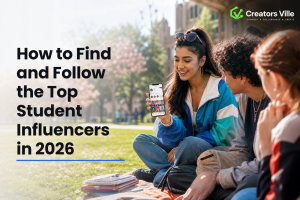

Start where real attention lives: search campus hashtags, scan uni-tagged posts, and sort by comments, not clout. To find follow top student influencers in 2026, use a simple rule, filter by niche fit, verify engagement quality, and only then follow or pitch.
Here’s the answer up front: identify creators who are students first and storytellers second, check their engagement rate over raw followers, review their comment sections for real talk, and scan posting consistency around classes and exams. Then, test a small collab before you scale. This guide shows you how to do it with examples, simple math, and tools that save time.
By the way, 2026 is a big year for student creators. More brands budget for campus voices, and more students treat content like a serious side job. That shift means better content, but also more noise. So, you need a clear method to separate signal from hype.

What Makes a Student Influencer Stand Out?
A student influencer is a current college or high school student who builds an audience by sharing life on and off campus, study habits, dorm hacks, thrift fits, meal preps, club sports, weekend trips, and more. The best creators don’t act like billboards. They share real wins and misses. You can feel the campus life in every post.
Authenticity beats polish. Top student creators don’t copy macro trends for views. Instead, they show class crunch weeks, late club nights, and what they buy on a tight budget. For example, a junior CS major breaks down their internship search and shares code tips. Their comments read like a study group, not a fan club.
Moreover, niche expertise sets them apart. A first-year dietetics student who posts $7 meal plans has a clear lane. Kinesiology majors can own short mobility routines for dorm rooms. Finance students can teach credit basics with real statements (redacted). Each niche builds trust faster than broad lifestyle content.
Engagement Over Follower Count
- Look at likes and comments as a share of followers. Simple math: (likes + comments) / followers.
- Scan saves and shares where visible. Those are stronger signals than likes.
- Read comments for quality. Do you see questions, mini-stories, and follow-ups—or vague emojis?
Consistency matters, too. Great student creators post on a steady cadence that works with classes: for example, 3 Reels per week + 2 Stories daily during midterms might drop to 2 + 1. They don’t ghost for a month, then dump ten posts. Instead, they set a pace and keep it.
Furthermore, relatability is the hook. The top creators speak like a friend in lab. They answer DMs.
They pin FAQs. They remember names. That’s why their audience shows up on day one of a giveaway or a club event.
Finally, balance sells the story. You can tell they’re students. They film between lectures, they tag clubs, and they shout out professors. This context shows a real life, which is why you should use this lens as you find follow top student influencers in your niche.
“Their honest reactions did more than any banner ever could. Engagement shot through the roof, and our Discord community doubled.” — PlayForge
Also Read!
How to Find the Best Student Influencers: A Step-by-Step Framework
You don’t need a huge tool stack to start. You need a search plan and a quick review workflow. Use these six steps and keep notes in a simple sheet.
Step 1: Search Campus-Specific Hashtags
Start with tags like #UCLA, #NYU, #ASU, #TarHeels, or the campus nickname. Then add niche words: #UCLAeats, #NYUfitness, #ASUthrift, #GATechCS. On TikTok and Instagram, sort by “Top” and “Recent.” This will surface steady hitters and fresh voices. As you scan, bookmark 10-20 profiles that feel student-led and niche-clear.
Step 2: Browse University-Tagged Content on TikTok/IG
Next, use the built-in location and university tag pages. Many creators tag their campus in Reels and Shorts. Tap through to creators who show dorms, clubs, or lectures. Save posts where the comments include real questions from peers. This is a fast way to find follow top student influencers who are active on campus.

Step 3: Check Engagement Rate, Not Just Followers
Don’t judge by follower count first. Instead, sample three recent posts and run the quick formula: (likes + comments) / followers. Write the three results and take the middle value. Then, compare post-to-post variance: if one post went viral but others are flat, be cautious. A stable pattern across posts is a stronger signal than one spike.
Step 4: Confirm Niche Relevance
Ask: Does this creator match your topic? If you sell dorm gear, a campus lifestyle creator beats a travel vlogger. If you sell note-taking tools, study-with-me beats fashion. Skim the last 12 posts. If fewer than 6 align with your niche, mark as “not a fit” and move on.
Step 5: Review Content Quality and Posting Frequency
Watch for clear audio, legible captions, and good light. Check if they post a steady cadence across 4-6 weeks. As a light rule, students who stick to a schedule, even if modest, tend to deliver on time. As you scale, this habit matters more than slick edits.
Step 6: Verify Authenticity via Comment Quality
Finally, scan the last 10-20 comments for each of 3 posts. Do you see friends, classmates, and real questions? Or do you see bots, pods, and one-word phrases? Real threads show a healthy audience. This step is where you should slow down. It’s also where you’ll spot your best partners.
As you adopt this framework, track creators in a sheet: profile URL, niche, campus, average views, mid-value engagement rate, comment quality notes, and first-collab idea. Then, use that sheet to prioritize who you will contact this week. Consistency across these steps is what helps you find follow top student influencers at scale without guesswork.
Common Mistakes When Evaluating Student Influencers
Here are six pitfalls that drain budget and time. Learn them once; avoid them for the rest of 2026.
First, chasing follower count over engagement. Big numbers can be hollow. A creator with 18,000 followers and deep comments can move more students to act than a 120,000-follower account with flat threads. Your review math should come before your gut.
Second, ignoring niche fit. A physics major who posts lab hacks is a poor match for a streetwear drop, even with high views. If the audience came for lab hacks, they won’t care about joggers.
Third, overlooking micro-influencers with 5k–50k followers. That range is prime for campus reach and tight trust. You can also run more tests across campuses without burning your budget in one bet.
Fourth, assuming all Gen Z creators are the same. A sophomore commuter at a public university lives a different day than a senior in Greek life at a private college. Their posts, pace, and price differ.
Fifth, not checking for fake followers. Bot-heavy threads have vague praise, no back-and-forth, and recycled comments. When in doubt, sample 50 followers: random empty profiles or new accounts with no posts are red flags.
Sixth, betting on one viral post. A one-off hit rarely repeats. You want creators with a repeatable process: a weekly series, a known filming slot, and a clear arc. That’s what holds up through finals week.
- Bad signs to watch for:
- Sudden follower spikes with no cause on-platform
- Comments flooded with unrelated emojis or “DM to collab” spam
- All views coming from one viral audio with no follow-up format
“Instead of flat catalog shots, they styled the outfits in everyday looks. The content felt natural, and within weeks, our hashtag hit 2M+ impressions.” — VogueRise
Moreover, as you refine your filter, remember this: your goal isn’t to “go viral.” Your goal is to match message to micro-culture. That edge wins on campus and scales past 2026.
For context on the broader field, see the overview on Influencer marketing.
Also Read!
How to Find and Learn From Innovative Marketing Campaigns in 2025
How to Run Influencer Product Seeding Campaigns for Marketing Agency Clients
Tools and Resources for Discovering Student Creators
You can do a lot with platform search. Still, a few tools make the hunt faster and cleaner.
- TikTok Creator Marketplace: Filter by topic, audience location, and sample content. It’s built for brand-creator deals and shows useful post stats. Use it to shortlist and then vet comment quality yourself.
- Instagram Search and Explore: Pair campus tags with niche tags, then save Collections by theme (e.g., “Dorm DIY,” “Study Routines,” “Club Sports”). Your Collections become a live roster.
- YouTube Trending in Education/Lifestyle: Scan Shorts and long-form for campus routines, dorm tours, thrift flips, and study methods. Many student creators cross-post; YouTube comments can show deeper trust.
- Influencer databases like HypeAuditor and Upfluence: These can help find audience lookalikes and flag fake growth. Use names and audience tags as leads, then always validate on-platform.
Furthermore, tools like Creators Ville combine search with AI creator matching. On one platform, you can search, filter, and connect with creators across niches, regions, and engagement levels, then launch campaigns with ready-made templates. It’s an AI-powered platform that connects brands with influencers and is trusted by 50,000+ brands and creators. Signing up is completely free. Mentioned results include an Olay Skincare Summer Campaign with 1.02M views and an 84% approval rate, and a Burger King Food Creator Campaign with 954k views and a 73% approval rate.
**Get instant creator matches →
As a result, this stack helps you find follow top student influencers with less manual work. Still, keep human checks for authenticity and niche fit. Tools should speed you up, not replace good judgment.
What to Do Next: Building Relationships with Student Influencers
Now that you have a short list, shift from search to trust. Relationships drive results, not mass emails. Here’s a simple path.
First, engage before you pitch. Like three posts, leave a real comment, and reply to one Story. Give it 3-5 days. Then send a short DM or email with one sentence of praise, one clear idea, and one next step. Keep it friendly and specific.
Second, start with small stakes. Product seeding works well on campus. Send a dorm bundle, a lab-ready tote, or a note-taking kit. Ask for one Reel or one Short with a simple brief and creative freedom. Then, if the content and comments land, scale to a paid collab.
Third, set clear expectations. Share deadlines, key talking points, a 1-line brand promise, and usage rights. Keep it tight, one page. Students juggle classes and clubs; clarity saves both sides time.
Fourth, measure what matters. Track content saves, meaningful comments, and traffic quality. Engagement beats vanity numbers. If a video drives real questions and club chatter, you’re on the right track.
Fifth, build for the long term. Offer a semester-based plan with check-ins around midterms and finals. That rhythm respects campus life and keeps content grounded.
- Simple workflow you can copy:
- Warm up with real comments
- DM with one idea and a ship-to link
- Ship product and a one-page brief
- Agree on one test post
- Review comments and saves
- Scale to a 60–90 day plan
Moreover, most platforms now support various campaign types, including paid collaborations and product seeding, so you can pilot, learn, and expand without heavy lift. That structure helps you find follow top student influencers you can work with for the rest of 2026.
Key Takeaways
- Engagement beats clout. Read comments, run the quick math, and favor steady threads over one-off spikes.
- Niche wins. Match your offer to a clear student niche—study skills, dorm life, club sports, campus food.
- Process scales. Use campus hashtags, uni tags, and a 6-step vetting flow to build a stable roster.
- Tools help. Platform search plus AI matching can cut the hunt time, but keep your authenticity checks.
- Relationships last. Seed first, measure real signals, then grow to semester-long plans.

What to Do This Week
Block 90 minutes. Day 1: save 20 campus creators via hashtags and uni tags. On Day 2: run engagement math and comment scans; narrow to 8. By Day 3: post real comments on each. On Day 4: DM your best 5 with one-sentence ideas. For Day 5: ship two seed kits. Across Days 6–7: prep briefs and tracking. Keep the loop tight, and by next week you’ll have content in motion, and a path to scale through 2026.