


Spreadsheet vetting didn’t make your campaigns smarter; it masked risk and burned hours. Teams switch to ai influencer discovery and matching to find real fit faster and reduce rework. The fastest way to add this to an agency workflow in 2026 is simple: lock KPIs, feed audience inputs, apply filters, let scoring pick the top tier, then have humans review and present options with clear trade‑offs.
You already know the grind: 40 tabs open, exports from social tools, a maze of CSVs, and a deck that took all week. That process scales poorly across five clients with different goals. AI changes the order of work. It moves the hardest parts, audience match and brand fit, upstream, so you spend your time on creative, pricing, and approvals, not on raw research.
However, AI does not replace your judgment. It makes it faster to get to a strong long list and shows data that manual checks miss. As a result, you spot risk sooner, you pitch with receipts, and you ship campaigns on time.

What Is AI Influencer Matching and Why Should Agencies Care?
AI influencer matching uses models to compare a creator’s audience, content themes, and engagement quality to your brief. Under the hood, it blends audience analysis (demographics, interests, geography), engagement scoring (quality of comments, post velocity), and brand-fit algorithms (tone, safety signals, product affinity). Think of it as an “always-on” analyst that reads posts at scale and flags fit.
By contrast, manual spreadsheet vetting relies on surface stats and human recall. You scan feeds, paste links, and hope your notes catch the full picture. That process breaks at scale. An AI-powered platform that connects brands with influencers can search, filter, and connect with creators across niches, regions, and engagement levels in minutes, not days.
Now, let’s talk time and error. With manual vetting, a coordinator might spend five minutes per profile just to decide “maybe.” On a 100‑profile list per client, across four clients, that’s hours of low-value work before you even start outreach. With AI, the tool can pre-score the 100 against your inputs and hand you a 12‑20 creator shortlist to review in depth. You still apply judgment, but you start from “probables,” not “possibles.” That’s how you reclaim full days across a month without cutting quality.
Moreover, accuracy climbs because AI checks signals you would skip under deadline pressure. It can weigh sentiment in comments, flag sudden follower spikes, and compare audience overlap between candidates. Therefore, you reduce the odds of picking creators who look big but won’t move the needle. If you need a primer for a client, point them to the basics of Influencer marketing for shared vocabulary.
What AI Actually Evaluates
- Audience makeup: age, gender, country, interest clusters
- Engagement quality: comment depth, save/share signals, posting cadence
- Content fit: topics, tone, brand safety language, visual style
- Commercial fit: past brand partners, pricing ranges, deliverable speed
“Experience one of its kind influencer marketing—connect with verified influencers, track real-time performance, and gain data-driven insights to build long-term, transparent relationships. No middlemen, no hidden fees.” — Customer testimonial
Step-by-Step: Implementing AI Influencer Matching in Your Agency Workflow
You don’t need to overhaul your stack. You need a clean handoff from client brief to shortlist. Use this six-step runbook across accounts.
- Start with one primary metric and one guardrail. For example, “CAC under $45” with a guardrail of “IG story taps to site above 1.3%.” Keep your north star clear. Therefore, your AI-Powered Campaign Matching inputs are not vague. Add a baseline for how you’ll measure: UTMs, platform codes, or checkout codes.
- Translate the brief into data fields: age ranges, top three interests, countries or DMAs, and languages. Then add psych cues, like “eco-conscious home cooks” or “budget gym fans.” Tools with data-driven insights can accept both hard filters and soft weights. As a result, the model knows what to trade off when the perfect match doesn’t exist.
- Pick platforms, post types, follower bands, and minimum engagement quality. In addition, set blocklists for categories you won’t touch. If the brand is skincare, you may exclude creators who promote injectables. Ready-made templates for quick campaign launches help your team move fast while staying consistent across clients.
- Run the match. Sort by score, but not only by it. Look at audience overlap between top creators to avoid redundancy. Then build two shortlists: a “safe bet” list and a “reach/alpha” list. Keep 8–12 names per list so pricing and schedule risk don’t stall you.
- Review the last 90 days of posts for sensitive themes, claims risk, and culture fit. Check fake-follower risk, recent sponsor mix, and sentiment. In fact, a quick pass with a tool’s Smart Analytics & Reports can flag spikes and outliers that merit a closer look.
- Package two routes with pros, cons, and estimated reach/sales bands. Therefore, you give choice without chaos. Attach creator cards that show audience notes, sample content, and draft hooks. Close with your plan for real-time performance tracking and analytics once the content goes live.

What “Good” Looks Like in 2026
- Every brief uses a repeatable template
- Shortlists arrive in under 48 hours
- Each creator card includes audience notes and a risk flag
- All picks map to one KPI with a forecast range
**Get a fast, free workflow review →
5 Mistakes Agencies Make With AI Influencer Matching
Chasing follower count. Big audiences mean little if the creator’s reach is flat or the comments are bots. Instead, weigh engagement quality and conversion history over raw size. Therefore, push scoring to reward saves, shares, and deep comments.
Ignoring audience overlap. If three creators share the same 60% of followers, your reach math breaks. As a result, you pay triple for the same eyeballs. Use overlap metrics to diversify your slate and reach net-new people.
Skipping fake-follower and velocity audits. A clean profile today can be suspect next week. So, add a quick integrity check for spikes, sudden ratio shifts, and paid comment farms. Smart Analytics & Reports should flag anomalies before they hit your client’s feed.
Not calibrating filters by vertical. Beauty, gaming, B2B, and food each have different “healthy” engagement bands and content formats. For example, a 1.5% rate might be fine for a mega tech YouTuber but weak for a micro beauty creator on Reels. Therefore, adjust your filters by niche benchmarks and campaign type.
Treating matching as set-and-forget. The shortlist is not the finish line. It’s the starting grid. Real-time performance tracking and analytics let you swap creators between waves, adjust hooks, and double down on what moves sales. In 2026, “launch and learn” beats “launch and hope.
Quick Self-Audit Checklist
- Are we ranking by quality signals, not just size?
- Did we check overlap across top picks?
- Do filters match this brand’s niche norms?
- Did we run safety and integrity checks this week?
- Do we have a plan to adjust mid-flight?
Tools and Platforms for AI-Powered Influencer Discovery
You have options. The right tool depends on your client mix, budget, and how deep you need to go on contracts and payments. Here’s a clear way to frame it when your team evaluates platforms.
Enterprise suites like CreatorIQ or Grin support complex orgs, deep integrations, and big data teams. They fit global brands with strict workflow needs. On the other hand, mid-market platforms such as Upfluence focus on discovery, outreach, and reporting with lighter admin. They suit agile agencies that want strong matching plus pragmatic ops.
Then there are focused tools like Infliuence, which include AI creator matching and the nuts and bolts you need to ship campaigns: built-in contracts, automated payouts, and tax form management. For agencies that juggle e‑commerce and DTC clients, having AI creator matching plus “do-the-work” features in one place saves hops between systems. As social proof, tools in this class are trusted by 50,000+ brands and creators. As a risk reversal, signing up is completely free, which lowers the barrier to pilot a new workflow with a single client.
Moreover, newer platforms add AI-powered recommendations and flexible workflow automation so coordinators spend more time on creative than admin. If your team values speed to first shortlist, look for “Most users are Live within 24 hours” and ask to see it during a trial. Also ask to “Track sales, engagement, and brand lift in one place” with clear dashboards that a client can read without a handhold.
Match Tool Type to Agency Needs
| Agency Scenario | Core Need | Tool Type To Explore |
|---|---|---|
| Global, 10+ markets, strict compliance | Integrations, governance | Enterprise suite |
| Multi-client, mixed budgets, quick campaigns | Fast matching, good reporting | Mid-market platform |
| DTC/e‑commerce heavy, lean team | AI creator matching + payouts/contracts | Focused all-in-one |
For a deeper walkthrough tailored to e‑commerce briefs, share this 2026 e‑commerce guide with your team. For a sales-focused primer you can send to clients, bookmark this step-by-step walkthrough.
**See pricing options in minutes →
What to Do Next: Putting AI Matching to Work This Quarter
Start with a one-client pilot. Pick a brand with clear goals and a fast approval loop. Then run your current process and the AI flow side by side. Capture two hard metrics: time-to-shortlist and cost per qualified post. Add a third “soft” metric: client confidence in the deck you present.
Next, set a four-week timeline. Week 1: agree on KPIs and audience inputs. Week 2: build filters and pull the first shortlist.
Week 3: run brand safety, outreach, and contracts. Week 4: measure early performance and tune the slate. Most users are Live within 24 hours on modern tools, so use that speed to keep momentum.
Finally, report like a CFO. Show how AI influencer discovery and matching changed the cost to ship a shortlist, how it affected reach quality, and what you’ll adjust in wave two. Keep the iteration loop tight. Track sales, engagement, and brand lift in one place so you can call winners and roll budgets with confidence.
Key Takeaways
- AI matching moves research upstream so humans spend time on creative and deals, not on manual vetting.
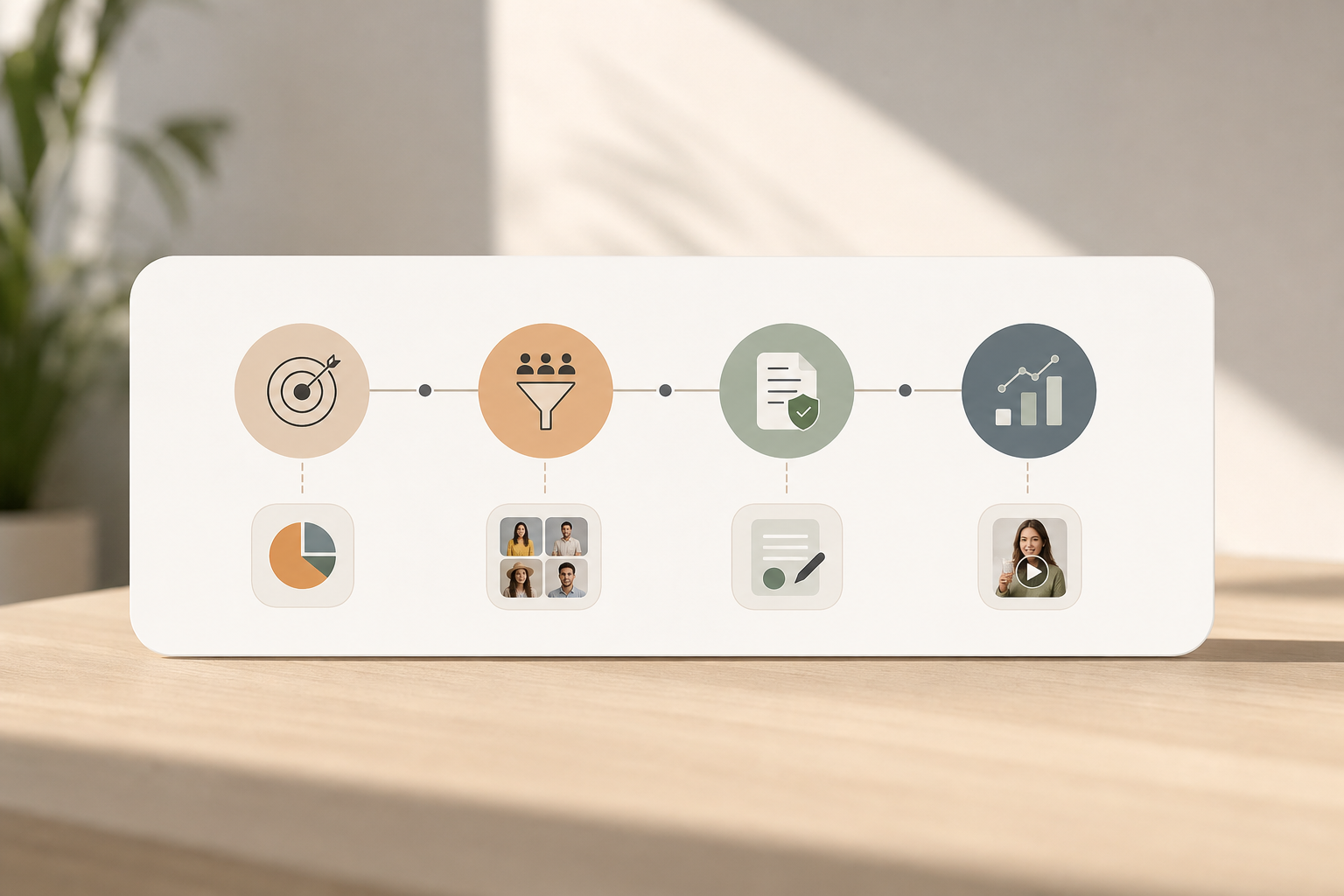
- A six-step workflow—KPIs, audience inputs, filters, scoring, safety, client deck—keeps teams fast and precise.
- Avoid five traps: size-chasing, audience overlap, fake-follower oversights, one-size filters, and set-and-forget.
- Pick tools by use case; for lean teams, AI creator matching plus payouts/contracts in one place removes friction.
- Prove value with a four-week pilot that measures time-to-shortlist and ROI against your 2026 goals.
What to Do This Week
Audit one active brief. Write the KPI and guardrail, define three audience traits, and list five blocked categories. Then run a tool to get a scored long list and build two shortlists. Book 30 minutes with the client to align on trade-offs and start outreach. If you want a quick gut-check on your setup, I’m happy to review a deck.