

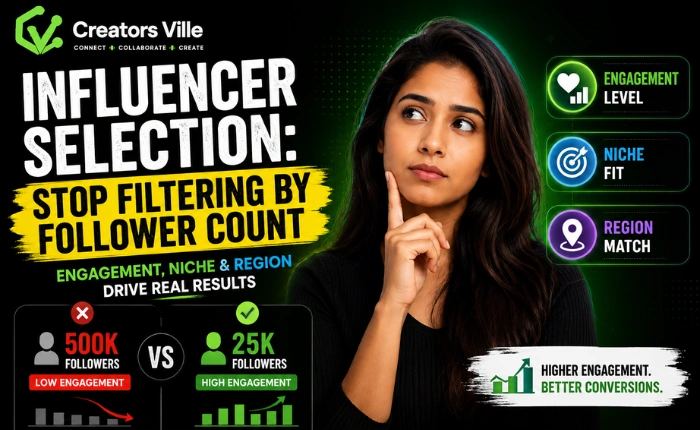
Niche creators who align with brand values drive 47% higher engagement and nearly double the conversion rate compared to mass-reach influencers. Yet the first thing most brand managers type into a creator search bar is a minimum follower count. That single habit is where influencer budgets quietly bleed out.
The pattern repeats across D2C startups and enterprise teams alike. The brief says “reach,” so the team filters for reach. They find a creator with a large following, pay a flat fee upfront, get a fraction of the expected views, and conclude that influencer marketing “doesn’t work.” The problem was never the channel. It was the filter.
In a hurry? Listen to the blog instead!
Why Follower Count Is a Vanity Metric Dressed as a KPI
Follower count measures an audience that was built — not one that is active. A creator who went viral once and hasn’t posted consistently since can carry a massive number while delivering near-zero engagement on any given post. Reach without engagement is impressions you paid for that nobody acted on.
Consider what an engaged audience actually does. 50% of people who follow influencers have made at least one influencer-suggested purchase — but that conversion only happens when the creator’s audience is genuinely attentive and the content is relevant to what they already care about. A large, disengaged following produces neither attention nor action.
66% of people who follow influencers are more likely to remember a brand an influencer recommends than one they saw in a traditional ad. That recall advantage evaporates when the creator-audience bond is weak. And that bond is measured by engagement level — not follower count.
The Three Filters That Actually Matter for Influencer Discovery
Follower count is one signal. It should be the last one you look at, not the first. Here is what to prioritise instead.
1. Engagement Level — the Real Pulse Check
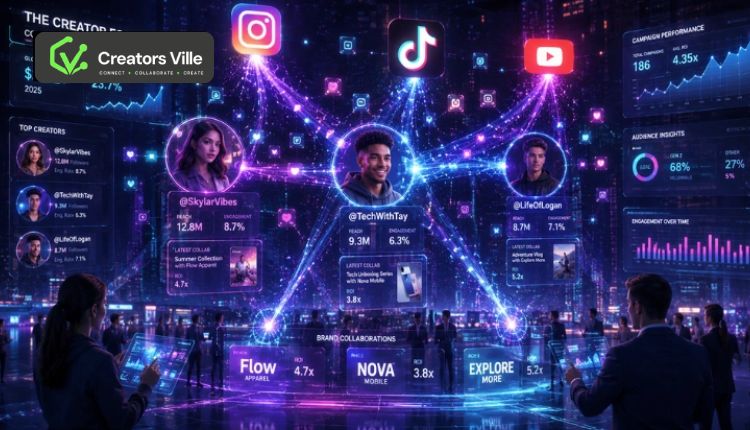
Engagement level tells you whether an audience is alive. Comments, shares, saves, click-throughs — these are the behaviours that precede a purchase. A creator with a smaller but highly active audience is a more valuable media buy than one with a vast but dormant following. The maths is simple; the discipline to act on it is not.
On Creators Ville, brands filter creators directly by engagement level alongside niche and region. That combination — niche relevance plus geographic fit plus proven audience activity — is what separates a campaign that converts from one that produces a nice-looking screenshot and not much else.
2. Niche Fit — Specificity Over Scale
A skincare brand partnering with a general lifestyle creator is leaving relevance on the table. A creator whose entire channel is built around Indian skincare routines, ingredient breakdowns, and honest reviews has an audience that showed up specifically for that content. The intent alignment is built in.
Niche filtering is not just about content category — it is about audience identity. The tighter the match between what a creator consistently talks about and what your product does, the shorter the persuasion gap. The 2025 Nielsen Influence Index data makes this concrete: campaigns with niche creators who align with brand values drive nearly double the conversion rate compared to mass-reach influencers.
3. Region — Because “India” Is Not a Target Audience
If your product ships only to Maharashtra and Karnataka, a creator based in Delhi with a primarily North Indian audience is a structural mismatch. That is true regardless of how strong their content is. Regional filtering lets you match not just language and culture, but the practical geography of where your customers actually are.
57.1% of brands use Instagram for influencer marketing, making it the leading platform for creator programmes. But platform ubiquity doesn’t solve geographic misalignment. Region matters as much on Instagram as it does anywhere else — and most brands still treat it as an afterthought.
The Influencer Selection Workflow That Changes the Outcome
Here is how this plays out in practice on Influence, using only what the platform actually does.
Step 1: Set your goals first, before you open the creator search. Influence has brands set up a profile with goals, budget, and target audience before they touch the search. This is not a formality. It forces you to define success before you fall in love with a creator’s aesthetic. Are you optimising for views, for engagement, for conversions? That answer changes which engagement-level threshold you set.
Step 2: Filter in order of niche → region → engagement level. Start broad on niche, narrow on region, then cut hard on engagement. Most brands do this in reverse — they sort by follower count first, then try to check whether the creator seems “relevant.” Reverse that order and your shortlist will look completely different. It is the single most practical change in influencer selection most teams can make this week.
Step 3: Let AI Matching surface what manual filtering misses. Influence’s AI-Powered Campaign Matching surfaces creators who fit your brief in ways keyword-based filters won’t catch. A fitness creator who posts heavily about nutrition supplements won’t always appear in a pure “supplements” niche filter. AI matching reads actual content signals. Use it as a second pass after your manual filters. For a deeper look at how AI-driven influencer discovery works at scale, this guide to AI influencer discovery and matching for e-commerce is worth reading alongside this piece.
Step 4: Pay for performance, not promise. Influence’s model has brands pay creators only for views generated — not upfront. This is structurally important when you are experimenting with new engagement-level thresholds, because the cost is tied to actual delivery. If a creator’s audience turns out to be less active than their engagement rate suggested, your spend reflects that reality rather than being locked into a flat-fee negotiation. See how Creators Ville’s pay-per-view model works →
Step 5: Monitor from the Live Campaign Dashboards — immediately. Don’t wait until a campaign ends to assess performance. Influence’s Live Campaign Dashboards give you real-time visibility into engagement and ROI as the campaign runs. If a creator’s content is underperforming against your benchmarks, you know quickly enough to adjust — rather than writing a post-mortem weeks later. For the full picture of what to track and when, this breakdown of influencer campaign analytics and ROI tracking covers the reporting layer in detail.
What Engagement-First Brands on the Platform Actually Do
The 50,000+ brands and creators on the platform who get the most from engagement-led filtering share one habit: they treat the initial filter stack as a hypothesis, not a final answer. They set an engagement threshold, run a campaign, read the Smart Analytics & Reports data, and update the threshold for the next one. Each cycle sharpens their understanding of what “good” looks like for their specific product and audience.
In practice, a D2C brand launching in a new city might start with a regional filter for that market. They layer on a niche filter for their product category, then set engagement level above the average for that creator size tier. They are not filtering for the biggest name — they are filtering for the most relevant active audience. The collaboration strategies that consistently boost engagement all share this same foundation: specificity of fit, not scale of reach.
The pay-per-view model matters here too. Because brands are not paying upfront flat fees, running engagement-led selections across multiple mid-tier creators — rather than betting on one large one — does not require a significantly larger budget commitment. It requires coordination infrastructure, which is where Unlimited Brand Collabs and Smart Analytics & Reports pulling everything into one view earn their keep.
The Trade-offs Worth Acknowledging
Filtering hard on engagement level does narrow your creator pool. That’s the point — but it carries a real implication. Creators with high, consistent engagement in a tight niche often have more inbound brand interest, which means they can be more selective about what they take on. The answer is not to loosen your engagement criteria; it is to make your brief genuinely attractive and your product-creator fit obvious from the first message.
Running multiple mid-tier creators in parallel is also operationally more complex than managing one large deal. Centralising it on a platform — with no middlemen and no hidden fees, as Creators Ville is structured — is what makes that model scalable without the overhead eating the margin. The operational lift is real; the infrastructure exists to absorb it.
One more trade-off: AI matching is a complement to judgment, not a replacement for it. It reads signals across a large creator pool that humans would miss or misweight at scale. No manual filter stack does that efficiently. But the editorial call — does this creator’s content actually feel right for our brand? — still belongs to a human. Use AI matching for discovery; use your own judgment for the final cut. The 65% of influencers who prefer to be involved in creative conversations early rather than follow a rigid brief are telling you something useful: the best creator relationships require human-to-human alignment that no algorithm closes alone.
One Practical Benchmark to Start With
If you have no internal baseline yet: filter for creators with engagement levels above the platform average for their size tier. Don’t set an absolute number — what counts as strong engagement shifts by platform, content format, and niche. The comparison should be relative to peer creators, not absolute. Start there, run a campaign, and let the Smart Analytics & Reports data set your next threshold. You will have a real number within one campaign cycle.
Most users on Creators Ville are live within 24 hours of setting up their workflow. The first campaign is where the learning starts. Each one either confirms or updates your engagement-level filter — and over time, that compounding data is worth more than any single large-follower bet.
Stop starting with followers. Start with engagement, niche, and region. The rest of the influencer selection decision gets easier from there.
Start your free Creators Ville trial and filter creators by engagement, niche, and region from day one.