


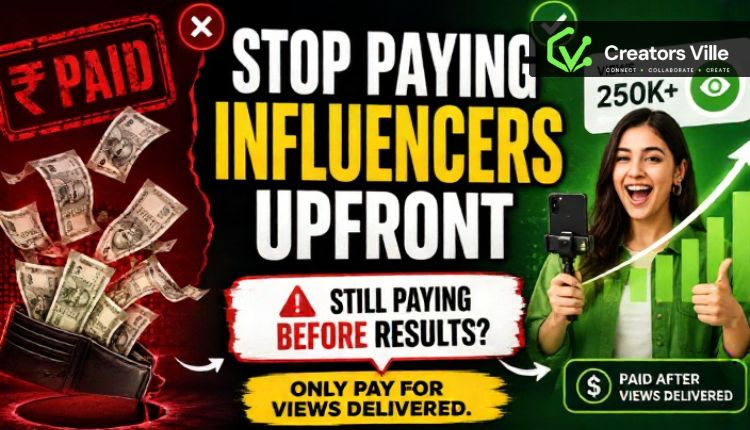
Most brands lose money on influencer marketing before the campaign even starts. The moment they wire a flat fee to a creator — before a single frame is filmed, before a single view is counted — the brand has already taken on all the risk. The creator has none.
This is the norm. It shouldn’t be.
I’ve spent a decade watching brands treat influencer payments like a media buy: pay the rate card, hope for the best, reconcile the damage in the post-mortem. The upfront flat-fee model made sense when influencer marketing was niche and untracked. It makes no sense now, when platforms give you real-time view counts and engagement data within hours of a post going live — and when the influencer marketing platform market has grown to $34.2 billion in 2025 and is projected to hit $116.2 billion by 2033. The infrastructure for accountability exists. Most brands just aren’t using it.
In a hurry? Listen to the blog instead!
The Math Problem No One Talks About
Here’s the uncomfortable truth about upfront payments: you’re pricing off follower count, not performance. And follower count is one of the least reliable signals in the industry right now.
A creator with a fraction of the following but a tightly engaged niche community often commands comparable fees to someone with ten times the audience and a disengaged one — yet most brands still anchor their budget conversations to the bigger number. They pay more for the wrong creator.
Then there’s fraud. Fake follower fraud — identifiable through anomalous follower spikes, follow/unfollow churn, and comment pods — can inflate vanity metrics without delivering buyers. Brands optimise for CPM. The delta only shows up after the budget is committed and the invoice is paid.
Paying upfront doesn’t just expose you to bad performance. It exposes you to bad data dressed up as good performance.
What “Pay for Views” Actually Changes
Creators Ville, trusted by 50,000+ brands and creators, runs on a different logic: brands pay creators only for the views generated, not upfront. That single structural shift changes the entire risk profile of a campaign.
When payment is tied to views delivered, the creator has skin in the game. Content quality matters. Posting timing matters. The creator isn’t cashing a cheque for showing up — they’re earning based on what their audience actually does.
For brands, this means your budget scales with real output. A campaign that underperforms costs you less. A creator who over-delivers earns more. That’s how performance-based relationships should work, and it’s remarkable how rarely the traditional model achieves it.
The shift is already underway at the industry level. Impact’s 2025 creator payment analysis found that traditional follower-based pricing is becoming irrelevant as algorithmic delivery reshapes how content reaches audiences — and by extension, how creators should be compensated. Paying a flat fee for follower count when reach is now algorithmically determined isn’t just inefficient; it’s pricing the wrong variable entirely.
The Three Mistakes Brands Make With Upfront Deals
1. Conflating reach with relevance
Upfront pricing pushes brands toward macro creators because the rate card is easier to justify to finance. But a micro-influencer with 30,000 followers in a specific niche can outperform a celebrity with 3 million followers when the audience match is tighter. Paying flat fees to large accounts often means paying a premium for audience dilution.
Micro-influencers — creators with between 10,000 and 100,000 followers — deliver noticeably higher engagement than celebrity-tier accounts, precisely because their communities are more homogeneous. You can build an entire campaign on ten well-matched micro-creators for what one macro creator charges upfront. With a views-based model, you find this out through performance data, not gut instinct.
And the consumer side confirms the logic: 76% of Americans now follow influencers, and half have already made a purchase based on an influencer recommendation in 2025. That purchasing intent is concentrated in niche communities — exactly where micro-creators operate, and exactly where flat-fee macro buys often miss.
2. Skipping niche and engagement filtering
One of the fastest ways to waste an upfront budget: find a creator with impressive surface metrics, pay them, and discover post-campaign that their audience was the wrong demographic entirely. Niche and value misalignment are invisible from surface metrics alone.
Creators Ville lets brands search and filter creators by niche, region, and engagement level before any conversation about budget begins. That filtering step — which takes minutes on a platform built for it — is what separates a well-matched campaign from an expensive mismatch. Do the filtering first. Always. The tier breakdown matters here too: nano creators (1K–10K followers) are best for hyper-local or niche brands; micro for most small to mid-size businesses; macro for established brands scaling reach; mega for national awareness. Each tier has a different cost-per-engagement reality, and none of that calculus works if you haven’t filtered by the right variables first.
3. Committing to creators before testing content direction
Upfront deals often lock in a creator and a deliverable in the same contract. If the content brief doesn’t land, or the creator’s style doesn’t convert for your product, you’ve paid for a lesson. A views-based model creates a natural checkpoint: you can see early performance signals before the full campaign budget is in motion.
This is why product seeding and gifting campaigns — where brands send product first and assess organic response before formalising a paid arrangement — have become a credible first step for e-commerce brands. It’s not about avoiding payment; it’s about sequencing risk intelligently.
What Brands Get Wrong About “No Hidden Fees”
When brands evaluate influencer platforms, they typically focus on the creator rate. They overlook the platform layer: middlemen fees, agency markups, and undisclosed commissions that sit between what the brand pays and what the creator receives.
Creators Ville operates with no middlemen and no hidden fees. That’s not a minor footnote. In an industry where agency margins on influencer spend are rarely disclosed, knowing the fee structure is transparent changes how you model campaign costs. For D2C startups especially — where every rupee of margin matters — the difference between a platform that passes through full creator earnings and one that skims is material to whether a campaign breaks even.
Building a Campaign That Doesn’t Start With a Wire Transfer
Here’s the practical framework. It works whether you’re running your first influencer campaign or your fiftieth.
Set up your brand profile with real budget parameters. Not aspirational numbers — actual budget. Creators Ville’s onboarding starts here: goals, budget, target audience. Getting this right before touching a creator list saves weeks of misaligned outreach.
Filter before you talk. Use niche, region, and engagement level filters to build a shortlist of creators who match on audience, not just follower count. This is where most brands under-invest time. The manual alternative — searching hashtags, sending cold DMs, and tracking results in spreadsheets — is how most campaigns still run, and it’s why they’re hard to scale.
Structure payment around views, not promises. The pay-for-views model means your spend is directly proportional to the reach you actually get. No guesswork, no upfront risk transfer to your side of the table.
Monitor from the dashboard, not your inbox. Creators Ville’s Live Campaign Dashboards give you performance, engagement, and ROI in one place. When attribution scatters across links, codes, and screenshots, decisions degrade into whoever’s opinion is loudest. A single dashboard keeps everyone on the same numbers.
Use early data to double down or redirect. The advantage of a views-based model is that weak early signals cost you less, and strong signals tell you where to allocate more budget. You can make that call in real time — not in the post-campaign debrief.
The Attribution Question You Must Answer Before You Start
Even the best payment model fails if you can’t trace views to outcomes. Influencer campaign ROI tracking is the discipline that turns a views-based model from a cost reduction into a genuine performance system.
Tracking mechanisms that actually work in e-commerce: UTM links, discount codes, and first-party pixel integrations. Each has trade-offs. UTM links break when users screenshot and share. Discount codes track conversion but not the full view-to-click journey. Pixel integrations are the most complete but require setup time. Know which you’re using before the campaign launches — not after.
The goal is a single attribution source of truth. Without it, you’ll end up with three teams exporting different CSVs and no one trusting the blended ROAS — which is where most upfront-paid campaigns end up anyway.
One Last Thing on the Upfront Model
I’m not arguing that creators should never receive upfront payment. For large production campaigns, travel shoots, or long-form content that requires significant creator investment, some upfront element is fair. What I’m arguing is that flat upfront fees as the default — regardless of campaign type, creator tier, or content format — is a habit that costs brands money and removes accountability from the relationship.
The structural logic is straightforward: when payment is algorithmically tied to views actually delivered, creators optimise for delivery. That’s not a theory. It’s the mechanism that Impact’s 2025 creator payment analysis identified as the defining shift in how modern influencer compensation is being redesigned.
Creators Ville is free to set up, and most users go live within 24 hours of setting up their workflow. That’s a low bar to clear to stop paying for performance you haven’t seen yet.
Start your free Creators Ville trial and run your next campaign on views delivered — not promises made.