

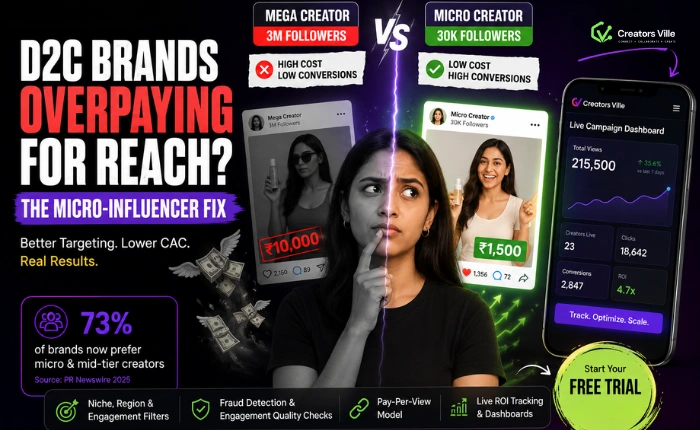
D2C brands already carry steep acquisition costs before a single influencer fee enters the picture. Paying $10,000 for one post from a creator with three million followers doesn’t fix that math. It accelerates the bleed.
I’ve watched this pattern repeat for a decade. A D2C brand lands a big creator, posts go live, the brand team celebrates the impressions, and then the attribution report comes back empty. No meaningful uptick in repeat buyers. A customer acquisition cost that looks worse than the paid search campaigns the brand already resented. And a CMO who quietly shelves influencer marketing as “unmeasurable.”
The problem isn’t influencer marketing. It’s reach addiction — the belief that a bigger audience automatically converts to more customers. It doesn’t. And the data in 2025 makes this impossible to ignore.
The Vanity Reach Problem
The reach metric is seductive because it’s big and clean. Engagement rate feels more rigorous, but it’s also misleading: a 3% engagement rate means nothing if the audience falls outside the buyer’s price sensitivity band. You can have a wildly engaged audience of people who will never buy your ₹2,500 skincare set.
Meanwhile, a micro-influencer with 30,000 engaged followers in a specific niche routinely outperforms a celebrity with 3 million followers on the performance metrics that actually matter to D2C brands — click-throughs, discount code redemptions, and second purchases. The mechanism is simple: a tight niche means a more homogenous audience, and homogenous audiences behave more predictably.
73% of brands now prefer working with micro and mid-tier creators, citing the strongest engagement-to-cost ratio. That’s not a trend. That’s a structural shift in how performance-focused brands allocate spend.
Why Big Creators Keep Getting Booked Anyway

Partly prestige. A recognizable name on the brand’s Instagram story feels like validation. Partly organizational pressure — a VP who needs a “big campaign” to show the board. And partly the path of least resistance: there are fewer mega-creators to evaluate than thousands of micro-creators, so the discovery process feels easier even if the outcome is worse.
But the economics of large creators are structurally hostile to D2C brands. Big creators price themselves out of most D2C budgets — fees are simply too high. The brands that can afford them tend to be legacy players chasing awareness, not conversion-hungry startups watching CAC daily.
Micro-creators, by contrast, are actively looking for collabs. They’re more responsive, more willing to implement tracking correctly — UTMs, unique discount codes, consistent tagging — and more motivated to perform because their brand relationship pipeline depends on results, not existing fame.
The Niche-Definition Failure That Kills Micro Campaigns

Running with micro-influencers doesn’t automatically fix the problem. There’s a specific failure mode that sinks otherwise well-intentioned micro campaigns: defining the niche too broadly.
“Fitness” is not a niche for a protein supplement brand. “Women’s functional fitness, 25–35, India” is closer. “Women’s functional fitness, 25–35, India, who train without a gym” is better. When the niche is too wide, you end up with creators whose audiences are technically “fitness-adjacent” but who skew toward aesthetics content, general wellness, or gym culture that doesn’t match your buyer.
This is where filtering precision matters more than platform size. Creators Ville lets brands filter creators by niche, region, and engagement level before outreach begins — which sounds obvious, but most brands still shortlist manually from spreadsheets and miss the regional specificity entirely. A creator based in Tier 1 cities promoting a product that ships faster to Tier 2 markets is a structural mismatch that only shows up after the campaign posts.
The One-Post Trap
Even when brands find the right micro-creator in the right niche, they often run one post and move on. That’s transactional, and transactional campaigns don’t build purchase intent.
A creator who mentions your product twice in three months signals personal use. A creator who posts once and never mentions you again signals paid placement — and audiences have learned to read that signal. D2C brands should be thinking about creators as channel partners, not billboards. The money is in the second and third orders, not the first purchase.
80% of brands either maintained or increased their influencer marketing budgets in 2025, with 47% raising budgets by 11% or more — but the ones winning are not just spending more. They’re building longer creator relationships that compound over time.
What a Better D2C Influencer Workflow Looks Like

The brands on Creators Ville that go live within 24 hours share one habit: they define their measurement framework before they touch outreach. Not after. The sequence matters.
1. Define the Metric Before Touching Outreach
Is this campaign optimizing for discount code redemptions, UTM-tracked site visits, or video views from a qualified audience? Pick one primary metric before filtering a single creator. Brands that skip this step end up with a dashboard full of impressions and no clear signal on whether the campaign worked. Every subsequent decision — creator selection, brief structure, payout trigger — should flow from that one metric.
2. Set Filters Before You Browse Creators
Use niche, region, and engagement level to narrow the pool before you look at a single profile. Engagement level filtering is particularly underused — brands often accept any creator above a follower threshold without checking whether engagement is authentic. Fraud signals to exclude include sudden follower spikes, follow/unfollow churn, and comment pods generating vanity metrics without purchase intent. These are rarely visible in a basic profile check; you need engagement quality signals — comment-to-like ratio, save and share rates, meaningful versus repetitive comment detection.
3. Confirm Tracking Readiness Before Briefing
Will the creator implement UTMs correctly? Can they use a unique discount code without improvising? Will they tag the content consistently across stories and posts? Tracking readiness is a pre-brief checklist item, not an assumption. Brands that skip this step lose attribution and then lose the internal budget argument to paid search — where tracking feels cleaner even when costs are higher.
4. Pay for Views, Not Potential
The performance-based payment model — paying creators only for views generated rather than upfront — exists precisely because flat fees don’t change creator behavior. Bolting a performance bonus onto a flat-fee base deal doesn’t fix it either; the base already provides the financial security that removes urgency to perform. When budget is tied to delivery, both sides take tracking seriously from day one.
5. Monitor from a Live Dashboard, Not a Weekly Report
Live Campaign Dashboards let you catch underperforming creators in week one. Redeploy that budget to whoever is actually driving results — before the rest of the campaign spend is committed, not after you read a month-end CSV. Real-time ROI tracking is the difference between a campaign you can steer and one you can only autopsy.
Why This Matters More in 2026
The influencer marketing category is growing because it works when done correctly. 92% of brands are already using or open to using AI to support influencer marketing — mostly for discovery and matching, which is where the manual process historically burned the most time and produced the most mismatches.
But the gap between brands that treat influencer marketing as a brand awareness play and brands that run it as a performance channel is widening fast. D2C brands still booking mega-creators for one-off posts in 2026 are playing a 2019 playbook against competitors who have figured out the performance model. Measuring influencer ROI accurately is no longer optional for D2C brands competing on tight margins.
The steep new-customer acquisition costs D2C brands already carry are not an influencer marketing problem. But the way most brands use influencer marketing makes those costs worse, not better. A creator with 30,000 deeply aligned followers is usually a better bet than a creator with 3 million who happens to post in your category. The filtering, the fraud checks, and the pay-per-view structure are what make that bet reliable rather than lucky.
Start your free Creators Ville trial — filter creators by niche, region, and engagement level, pay only for views delivered, and monitor every campaign from a single live dashboard.