

Follower count is the most expensive number in influencer marketing. Brands filter on it first, weight it hardest, and then wonder why a creator with a massive audience delivered fewer sales than one with a fraction of the reach. The filtering wasn’t broken — it was filtering for the wrong thing.
Here’s the non-obvious truth: by the time you’ve opened a creator’s profile to check their follower count, you’ve already reached the least predictive number on the page.
The Metric That Feels Safe But Isn’t
Follower count became the default filter because it’s visible, comparable, and feels objective. Engagement rate replaced it as the “smarter” metric. Neither is wrong exactly — but both are easy to game and both measure audience size proxies rather than purchase intent signals.
The reason niche creators so often outperform macro accounts on D2C metrics comes down to audience composition, not volume. A smaller creator whose audience self-selected around a specific topic — oily-skin skincare, home baking, trail running — has assembled people with shared purchase context. That’s not reach; that’s a qualified room. But most creator vetting workflows are still built around size, not context.
Even engagement rate — likes divided by followers — is a blunt instrument. A creator can post strong engagement numbers built almost entirely on comment pods and follow/unfollow churn. That figure tells you nothing about whether their audience buys.
The Signals That Actually Predict Sales
There are two layers of creator signals worth building your influencer filtering around: authenticity signals and intent signals. Most brands only look at the surface of the first and ignore the second entirely.
Authenticity Signals — Is the Audience Real?
Before anything else, you need to know the audience exists and isn’t manufactured. The signals worth checking, per established engagement authenticity analysis:
Comment-to-like ratio — a healthy ratio sits in a consistent band. When likes spike but comments flatline, or comments are overwhelmingly single-emoji and repetitive, that’s a pod signal.
Meaningful comment rate — comments that reference the content specifically (a product detail, a moment in the video) are nearly impossible to bot. Repetitive comments (“So good!” “Love this!” in sequence from different handles) are not.
Follower spike velocity — organic growth is gradual. A creator who gained tens of thousands of followers in a single week and then flatlined has almost certainly purchased them. Check the growth curve, not just the total.
Audience geography drift — a creator based in Delhi whose audience is disproportionately clustered in accounts with no location history is a flag worth investigating before you commit spend.
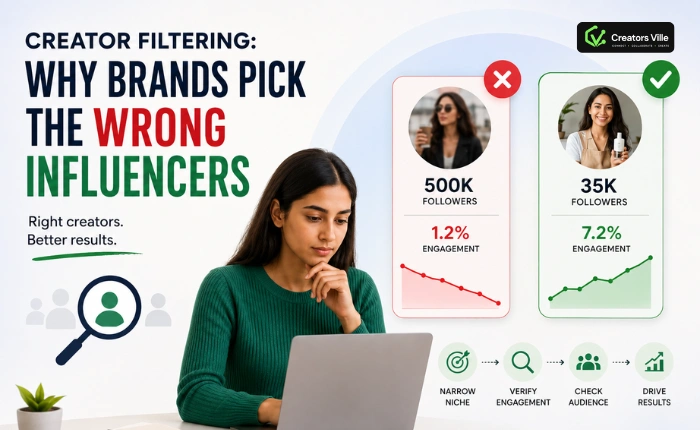
None of these require a data science team. They require looking at the right column instead of the wrong one. Consider the benchmark published in Creators Ville’s creator database guide: a 75k-follower dog trainer with 7% real engagement will outperform a 500k lifestyle account with 1% engagement and a teen-skewing, wrong-geo audience — for almost any pet brand, every time. Size lost. Context won.
Intent Signals — Will the Audience Buy?
This is where most creator vetting frameworks stop too early. Once you’ve confirmed authenticity, the question becomes whether the audience takes action beyond a double-tap.
Save rate is a strong purchase predictor. A save means someone bookmarked the content to return to it — a fundamentally different behaviour than reflexive liking while scrolling. Watch time carries similar weight: sustained attention to a product demo is qualitatively different from a half-second impression. The problem is that these numbers aren’t usually available before you’ve run a campaign with a creator.
The practical workaround: filter hard on niche depth and comment specificity as the best available proxies for genuine intent. A comment that names the product, references a detail from the video, or asks a follow-up purchase question is worth more than a hundred fire emojis.
A Four-Step Creator Filtering Framework You Can Run This Week
Creators Ville — the influencer-marketing platform trusted by 500+ brands across India — structures creator discovery around niche, region, and engagement level, which maps exactly to the layers above. Here’s how to sequence the filters so you’re catching the right signals at each stage.
Step 1: Lock Niche Before Anything Else
Not “beauty” — that’s a category. “Oily-skin skincare under ₹500” is a niche. “Home baking for working parents” is a niche. The narrower your niche filter, the more likely you are to reach an audience with a shared purchase context. A creator in a tight niche also has comments that reference specific products and routines — which is exactly the meaningful comment signal you’re screening for in Step 2.
Step 2: Use AI Matching to Surface Candidates, Then Manually Audit Comments
AI-Powered Campaign Matching can dramatically narrow a long list to a relevant shortlist. It works best as a first pass, not a final answer. Once the shortlist is down to 20–30 creators, spend five minutes per creator reading their last ten posts’ comments. You’re looking for specificity — did anyone mention using the product, trying the recipe, buying the thing? Generic praise is abundant and worthless. Specific reference is rare and valuable.
As BrandChamp’s influencer risk analysis notes, drilling into audience demographics, engagement authenticity, and past performance is what ensures every creator actually aligns with your target market — not just your target aesthetic.
Step 3: Filter by Engagement Level Last, Not First
Here’s where most workflows are inverted. Engagement level should be a filter applied after niche and authenticity, not before. A creator who passes the niche filter and the comment audit at a modest engagement rate is worth more than one who fails both at a higher rate.
Also watch for anomalies. A sudden engagement spike of more than 3x baseline, or a foreign-geo follower concentration exceeding any reasonable threshold for your target market, should trigger a flag before you scale spend. Those anomalies — comment-to-like ratio breaks, audience geography drift, sudden follower surges — are the bot and fraud signals that survive a surface-level engagement check.
Step 4: Run a Small Test Before Committing Budget
The single most important structural advantage of a pay-for-performance model is that it lowers the cost of being wrong about a creator. When a brand pays only for views generated rather than upfront flat fees, testing five creators to find two who actually move product is a rational strategy rather than a budget-wrecking experiment. This is the model Creators Ville is built around — no hidden fees, no middlemen, performance-linked spend.
Once you have real performance data — actual watch time, save rates, click-through — filter backward. In performance-focused campaigns, a small minority of creators typically drives a disproportionate share of outcomes. That pattern isn’t unusual; it’s the norm in creator marketing. The insight only becomes available after you’ve run the campaign, but it tells you exactly who to scale with and who to filter out next time.
What Goes Wrong Even With Good Filtering
Two failure modes survive even a solid filtering process.
First: filtering by region without filtering for audience location. A creator based in Mumbai with a large audience in the UAE is not the right fit for an India-only D2C campaign, regardless of how well they pass the niche and engagement checks. Always verify audience geography, not just creator geography.
Second: treating your shortlist as static. A creator who showed strong save rates months ago may have pivoted to sponsored content-heavy posting that has eroded that signal since. Run your vetting audit on recent posts — last 30 days minimum — not the highlight reel their media kit showcases.
The Filtering Problem Is Also a Measurement Problem
You can’t improve your creator filtering without closing the loop on what actually worked. Measuring influencer ROI correctly — with a full cost definition that includes gifted product, editing fees, and shipping alongside creator fees — is what tells you which filtering criteria predicted real performance. Brands that track this systematically build filtering frameworks that sharpen with every campaign. Brands that don’t repeat the same expensive mistakes in a different creator’s name.
According to CreatorIQ’s 2026 creator economy report, the creator economy only gained momentum last year — at higher volume than ever, across multiple industries. The brands that compound inside that growth will be the ones who treated filtering as the most consequential decision in the entire workflow, not a pre-campaign chore.
Get the filter right, and everything downstream gets easier. Get it wrong, and no amount of creative, budget, or optimisation will rescue you.
If you’re ready to build a creator shortlist against the right signals — not follower count — start your free Creators Ville trial and run your first filtered search today.